

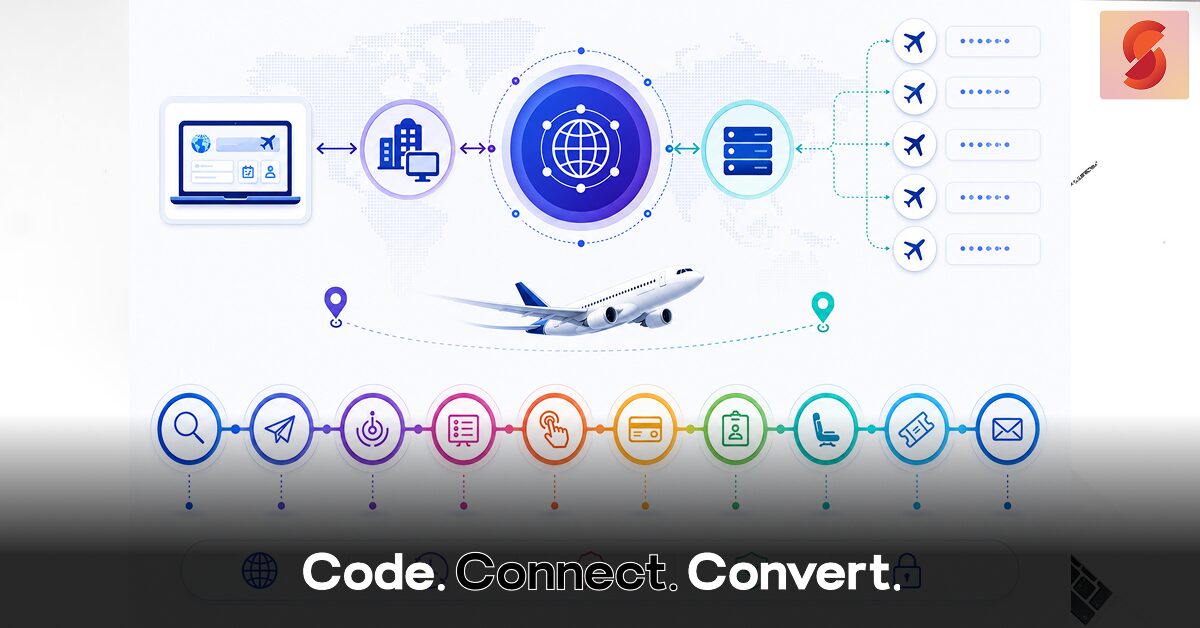
A Global Distribution System (GDS) is a computerized network that connects airlines, hotels, car rental companies, and other travel suppliers with travel agencies and online travel agencies (OTAs), enabling real-time search, pricing, availability, and booking of travel services.
It’s been a wonderfully digitised travel industry over the past few decades. Essentially, under each and every flight search, airline reservation, and travel booking is a complex technology ecosystem that provides an integration of seamless connectivity between airline, travel agency, online travel agency (OTA), corporate travel management company, and traveller.
The GDS is one of the most crucial technologies driving this ecosystem. It is a single source of information for airlines to provide their flight schedules and for travel agents to access, compare and book travel packages in real time.
If you are a travel agency, OTA, airline, travel startup or travel technology firm, knowing how GDS works is a must to thrive in the current travel industry.
This in-depth guide will cover all you need to know about GDS, from their origins to their benefits, major companies, booking processes, future trends, and why they are still a key component of today’s travel tech.
What does a Global Distribution System (GDS) mean?
Global Distribution System (GDS): A computer network that links travel suppliers like airlines, hotels, car rental firms, rail companies, and cruise lines to travel sellers like travel agencies and online travel booking companies.
A GDS is intended to offer instant access to travel offer, travel costs, travel timetables and travel availability on one single platform.
How GDS Works
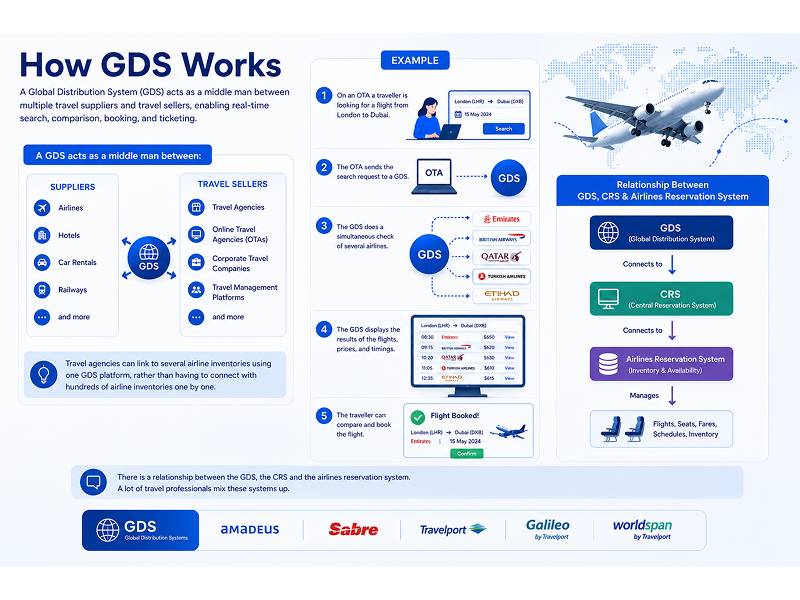
A GDS acts as a middleman between:
• Airlines
• Travel Agencies
Online Travel Agencies (OTAs):
• Corporate Travel Companies
• Travel Management Platforms
Travel agencies can link to several airline inventories using one GDS platform, rather than having to connect with hundreds of airline inventories one by one.
Example:
On an OTA a traveller is looking for a flight from London to Dubai.
The OTA sends the search request to a GDS.
The GDS does a simultaneous check of several airlines, such as:
• Emirates
• British Airways
• Qatar Airways
• Turkish Airlines
• Etihad Airways
The GDS displays the results of the flights, prices, and timings, and the traveller can make a comparison and book the flight.
There is a relationship between the GDS, the CRS and the airlines reservation system.
A lot of travel professionals mix these systems up.
| System | Purpose |
| Airline Reservation System (ARS) | Used by an airline to manage flight inventory, fares, reservations, and passenger records. |
| Central Reservation System (CRS) | Stores inventory and reservation data for travel suppliers, most commonly hotels and airlines. |
| Global Distribution System (GDS) | Distributes inventory to travel agencies, OTAs, and other sellers worldwide. |
History of GDS
The History of Airline Reservation Systems.
In the pre-computer era, airlines used manual reservations, paper records and the telephone to handle reservations.
It took a lot of time and organization to book a flight.
The computerization of reservations began in the 1960s.Reservation computerization started in the 1960s.
During the 1960s, airlines started to work on automated reservation systems.
The most notable system was: SABRE. Developed jointly by American Airlines and IBM. SABRE was one of the first comprehensive airline reservation systems in the world.
The Evolution of the GDS Platforms: The History of GDS Platforms.
With the growth of air travel around the world, airlines realized the need to share inventory beyond their offices.
This resulted in the creation of world wide distribution networks that were able to link thousands of travel agents across the globe.
Major Milestones Timeline
| Period | Milestone |
| 1950s | Manual airline reservation systems were widely used. |
| 1960s | SABRE and other computerized reservation systems emerged. |
| 1970s | Airline inventory management became increasingly automated. |
| 1980s | GDS access expanded across travel agencies. |
| 1990s | Online travel booking began to scale. |
| 2000s | International expansion and API-based integrations accelerated. |
| 2010s | Mobile booking transformed traveler behavior. |
| 2020s | NDC, API-first distribution, and AI-powered travel retailing gained momentum. |
How GDS Revolutionised the Travel Industry
GDS revolutionized travel by enabling:
• Real-time booking
• Global inventory access
• Automated ticketing
• Faster customer service
• Corporate travel management
• Multi-airline comparison
Today’s travel booking sites would not be possible without GDS technology.
Main Benefits of a GDS
| GDS Benefit | Description | Key Advantages |
| Real-Time Flight Availability | Travel agencies have immediate access to airline availability. | • Accurate seat availability • Up-to-date flight schedules • Reduced booking errors |
| Access to Multiple Airlines | There are hundreds of airlines that can be accessed from a single platform. | • Better customer choices • Competitive pricing • Simplified operations |
| Faster Booking Process | Bookings can be done in just a few minutes by travel consultants. | • Increased productivity • Higher booking volume • Improved customer satisfaction |
| Global Inventory Access | Travel agencies are able to sell tickets across the globe. | • International expansion • Wider travel offerings • Increased sales opportunities |
| Increased Revenue Opportunities | Agencies can generate income from various travel services. | • Airline commissions • Service fees • Ancillary revenue |
| Reduced Operational Costs | Automation minimizes manual tasks and administrative work. | • Lower staffing costs • Reduced errors • Faster processing |
| Improved Customer Experience | Travelers benefit from more options and a smoother booking process. | • More flight choices • Better fare comparisons • Faster booking experience |
| Better Travel Management | Corporate travel companies can manage bookings more effectively. | • Policy compliance • Expense control • Reporting and analytics |
Most Popular GDS Software
The three dominant players in the market for the Global Distribution System (GDS) are Amadeus, Sabre and Travelport.
- Amadeus is a company with headquarters in Madrid, Spain, which has a strong focus on airline distribution, innovation and a rich traveler support offering for air, hotel, car and rail.
- Sabre, headquartered in Texas, USA, is known for its comprehensive airline connectivity and is a popular choice for travel agencies and airlines around the world to book flights, hotels, and car rentals.
- Travelport, based in the UK, is a leader in multi-channel travel retailing, offering access to a comprehensive suite of travel services, such as flights, hotels, car rentals and rail transport.
All three of these providers are essential in driving a large amount of travel bookings across the globe and are the main pillars of travel distribution today.
Features and Advantages of GDS
Flight search and booking system.
How It Works: Enter travel information. The GDS queries the airline inventories.
Benefits for Travel Agencies
• Faster search results
• Access to more airlines
Benefits for Customers
• More options
• Better prices
Fare Management
How It Works: Published and negotiated fares are retrieved by the GDS.
Agency Benefits
• Competitive pricing
• Corporate fares
Customer Benefits
• Lower travel costs
Real-Time Availability
How It Works: Stock is kept up to date on a regular basis.
Benefits
• Accurate bookings
• Reduced overbooking risks
Multi-Airline Comparison
How It Works: The GDS collates the flight information of several carriers.
Benefits
• Better route planning
• Price transparency
Seat Selection
How It Works: The airline’s system is used to retrieve seat maps.
Benefits
• Improved traveler experience
• Additional revenue opportunities
Ticket Issuance
How It Works: Payments to create electronic tickets.
Benefits
• Instant confirmation
• Automated workflows
Ancillary Services
Includes:
• Extra baggage
• Meals
• Lounge access
• Priority boarding
Benefits
Additional revenue generation.
Refund and Cancellation Processing
How It Works: Changes are accomplished via airline rules.
Benefits
• Faster service
• Improved customer support
Reporting and Analytics
Travel agents can monitor:
• Revenue
• Bookings
• Routes
• Customer behavior
API Integration Capabilities
Today’s GDS providers have APIs that support:
• OTA development
• Mobile applications
• Travel startup platforms
• Meta-search integrations
GDS Booking Flow
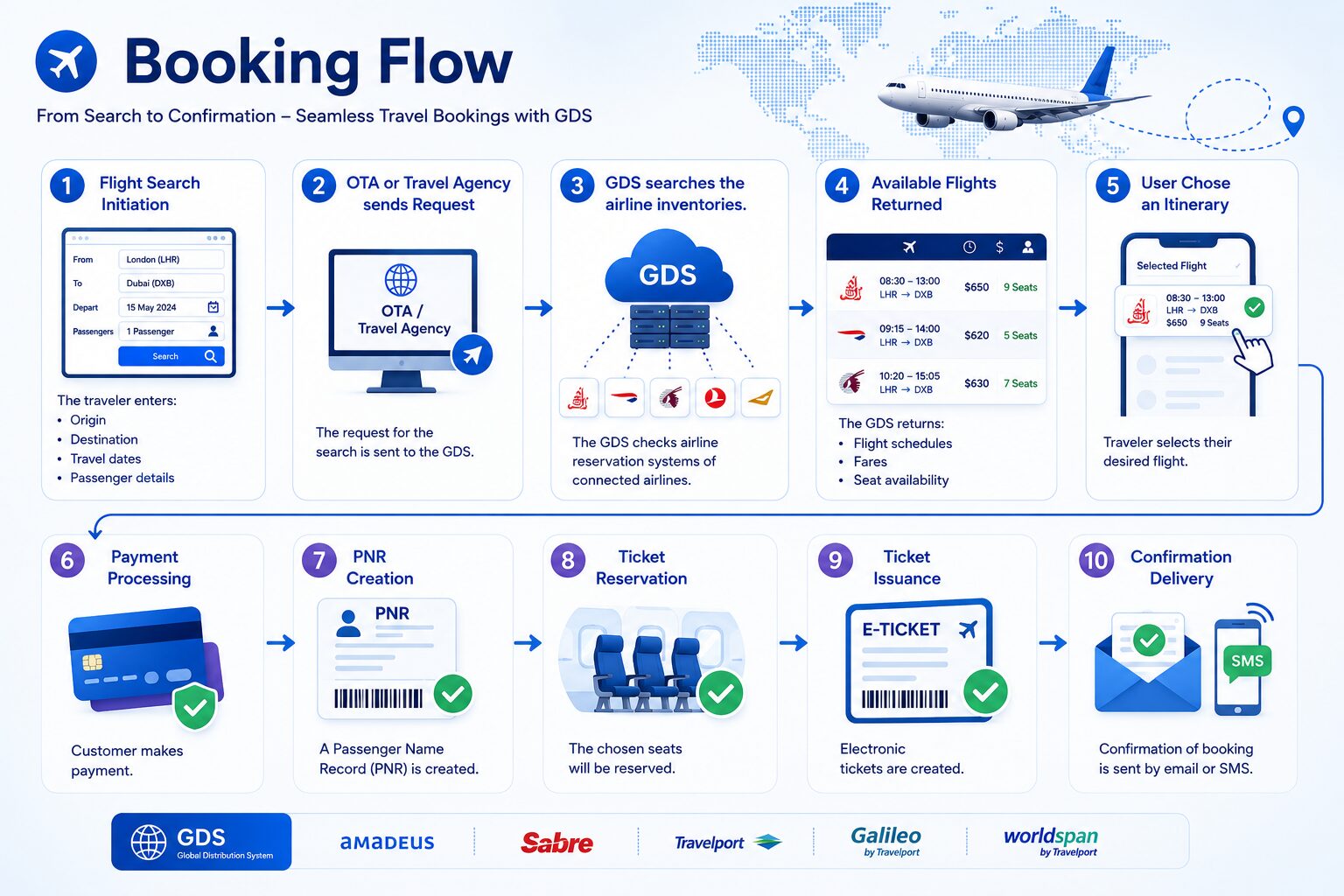
The GDS booking process ensures smooth and automated travel reservations.
Step 1:Flight Search Initiation
The traveler enters:
• Origin
• Destination
• Travel dates
• Passenger details
Step 2: OTA or Travel Agency sends Request
The request for the search is sent to the GDS.
Step 3: GDS searches the airline inventories.
The GDS checks airline reservation systems of connected airlines.
Step 4: Available Flights Returned
The GDS returns:
• Flight schedules
• Fares
• Seat availability
Step 5: User Chose an Itinerary
Traveler selects their desired flight.
Step 6: PNR Creation
A Passenger Name Record (PNR) is created.
Step 7: Ticket Reservation
The chosen seats will be reserved.
Step 8: Payment Processing
Customer makes payment.
Step 9: Ticket Issuance
Electronic tickets are created.
Step 10: Confirmation Delivery
Confirmation of booking is sent by email or SMS.
Why Travel Agencies are still using GDS.
- Centralized Booking Management
- A single platform that can be used by several suppliers.
- Negotiated Fares are available.Negotiated Fares are available.
- Special agency and corporate pricing.
- Corporate Travel Management
- Compliance with and reporting on policies.
- Global Airline Coverage
- Access to airlines across the globe.
- Efficiency and Automation
- Lowered labour and operational expenses.
Future of GDS
New Distribution Capability (NDC)
NDC enables airlines to offer more valuable and personalised offerings.
Benefits:
• Better merchandising
• More ancillary sales
• Improved customer experience
AI-Powered Travel Booking
Artificial intelligence enables:
• Personalized recommendations
• Smart pricing
• Predictive analytics
Dynamic Pricing
Dynamic fare optimization, based on demand.
API-First Architecture
Today, APIs are commonly employed in the modern travel platforms for:
• Mobile apps
• OTA platforms
• Travel startup solutions
Modern Airline Retailing
Future GDS platforms will be able to support:
• Personalized offers
• Bundled travel products
• Real-time merchandising
Final Thoughts
Global Distribution Systems are now the backbone of today’s travel distribution. They offer travel agencies, OTAs, airlines and travel technology companies with centralized access to flight inventory, real-time availability, pricing, ticketing, and travel management.
GDS platforms offer integration with airlines globally, allowing travel sellers to efficiently distribute travel, maximize revenues, enhance customer experience, and manage travel operations on a scalable level.
As new technologies like NDC, AI-driven travel booking solutions, dynamic pricing, and API-first approaches transform the travel tech landscape, GDS is still playing a vital part in the worldwide travel technology ecosystem.
To create comprehensive flight booking platforms, incorporate airline data, or create a next-generation OTA platform, travel companies need to grasp the nuances and power of GDS technology.
Scripterlab: Your Top-Notch Travel Technology Solutions and GDS Development Partner.
Our extensive experience in Global Distribution Systems (GDS) and custom flight booking systems development for travel agencies, OTAs, airlines and startups gives us a solid understanding of your needs. Our solutions connect to the major GDS systems (Amadeus, Sabre, Travelport and others) and are flexible enough to meet the needs of modern applications, including NDC support.
Our specialty is creating end-to-end travel portals that integrate GDS connectivity, intuitive user experience, real-time inventory, payment solutions, and sophisticated analytics. From white-label booking engines to CRM integration and complete B2B/B2C solutions, our team provides scalable, secure, and high-performance systems.
We built Vibes Group UK’s comprehensive travel booking platform, a renowned UK travel and tour agency. It offers integrated GDS and suppliers connections that enable seamless flight, hotel, package and activity bookings, ensuring an excellent user experience with the “Good Vibes Only!” efficiency. Read the full case study here.
Make partnership with Scripterlab a step towards the future of your travel company. Talk to us today and see how our GDS experience can be used to help you grow in the competitive travel tech market.
Looking to create your next travel app? To talk about your travel technology requirements and GDS integration needs, contact Scripterlab
FAQs about Global Distribution System (GDS)
How long does it take to integrate a Global Distribution System into a travel platform?
Integration time depends on the provider, API readiness, and platform complexity. It can take anywhere from a few weeks for basic connectivity to several months for full-featured enterprise integration with payments, ticketing, and custom workflows.
Can a travel agency connect to more than one GDS at the same time?
Yes, many modern travel platforms integrate multiple GDS providers to increase flight options, improve pricing competitiveness, and reduce dependency on a single system.
What is the difference between direct airline API and GDS connectivity?
Direct airline APIs connect a platform to a single airline’s inventory, while a GDS provides aggregated access to multiple airlines through one unified interface.
Are there limitations when using a Global Distribution System?
Yes, some limitations include dependency on airline participation, occasional fare mismatches, system latency during peak traffic, and additional costs for API usage or booking fees.
Is GDS suitable for small travel startups?
Yes, but small startups often start with API-based aggregators or white-label solutions before moving to full GDS integration due to cost and certification requirements.